

A larger parking lot won’t fix a confusing Sunday arrival. The key to how to handle parking for a large church congregation is to give people a clear plan before they pull in. When attendance varies from week to week, even a familiar lot can fill unevenly, leave visitors unsure where to go, and slow departures.
You can make arrivals easier without adding spaces first. Start by comparing typical and peak attendance with the spaces you can actually use, then map entrances, walking routes, and any overflow options. Clear directions and well-defined volunteer roles can help drivers find the right place to park. When your lot cannot fit everyone, church parking listings and scannable signs can help people find and understand available options before they arrive.
Key Takeaways
- Learn how to handle parking for a large church congregation by comparing typical and peak attendance with the spaces you can actually use.
- Map entrances, accessible routes, and pedestrian paths so members and visitors can find the right way in.
- Give volunteers clear guidance roles and a simple arrival sequence to help reduce confusion during busy services.
- Compare clearer on-site directions, overflow arrangements, and CurbFlip church parking listings to find a practical fit for ongoing needs.
How to plan parking for a large church congregation
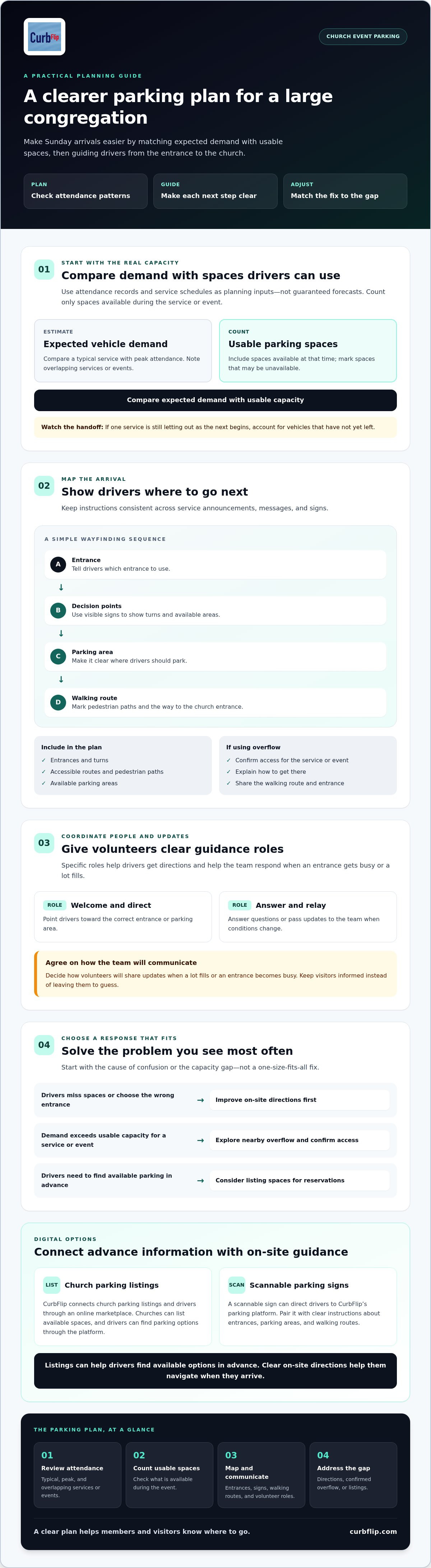
Start with attendance patterns rather than a guess. Review attendance for typical services and the highest-turnout dates, then check the calendar for overlapping services or events. Seasonal gatherings and services ending as another begins can create arrival and departure surges, even when total attendance seems manageable.
Next, count the spaces drivers can actually use during each service or event. Mark entrances, accessible routes, and pedestrian paths, and note spaces that may be unavailable. Parking capacity is the number of usable spaces available during the event. Compare that figure with expected demand to see whether your current layout is likely to be sufficient.
For context on different parking arrangements, explore these parking strategies.
Here’s a video related to the challenge of finding parking at church:
How do you estimate church parking demand?
Use attendance records and service schedules as planning inputs, not guaranteed forecasts. Compare a typical service with peak attendance, then note any overlapping services or events. If one service is still letting out as the next begins, allow for vehicles that have not yet left instead of assuming every space will be available to arriving drivers.
Estimate how many vehicles may arrive and compare that demand with usable spaces. If the estimate exceeds capacity, record the shortfall and decide what to address first, such as clearer arrival guidance, a revised schedule, or confirmed overflow. This gives your team a concrete starting point for how to handle parking for a large church congregation.
How to organize church parking arrivals and overflow
A clear arrival sequence helps drivers make decisions before they reach a crowded entrance. Tell people which entrance to use, where to turn, which areas are available, and how to walk from each parking area to the church entrance. Keep directions consistent across service announcements, messages, and signs.
Place visible signs at decision points, including the driveway entrance and turns toward different parking areas. Make pedestrian paths easy to follow, especially where they cross vehicle routes. For sign-system ideas, see the guide CurbFlip Scannable Parking Signs. CurbFlip’s scannable church parking sign can direct drivers to its platform.
What should a church parking plan communicate?
Give drivers the same simple directions at each step: where to enter, where to park, and how to reach the church entrance. If you’re using overflow, explain where it is, how to get there, and which entrance to use. Confirm that the location is available for the service or event before directing drivers to it.
Assign volunteers specific guidance roles. One can welcome drivers and point them toward the correct area; another can answer questions or pass updates to the team. Agree on how volunteers will communicate when a lot fills or an entrance becomes busy. Their role is to guide drivers and keep the team informed, not to leave visitors guessing about changes.
If on-site spaces are limited, assess nearby church event parking options and confirm access with the property owner or organizer before sharing them. Communicate the location and walking route in advance. For congregations exploring scannable signs, view CurbFlip’s parking sign options. A clear, flexible plan is a practical part of how to handle parking for a large church congregation.
How to choose a church parking solution for ongoing needs
Match the approach to the problem you see most often. If drivers miss available spaces or choose the wrong entrance, improve on-site directions first. If demand exceeds your lot’s usable capacity during specific services or events, explore nearby overflow and confirm access before directing drivers there. If drivers need to find available church event parking in advance, listing spaces for reservations may be a useful option.
CurbFlip connects church parking listings and drivers through an online marketplace. Churches can list available spaces, and drivers can find parking options through the platform. Listings can help communicate availability for busy services or events, while clear on-site directions help drivers navigate once they arrive.
When can digital reservations and scannable signs help?
Consider reservations when advance information could help drivers find available spaces and understand where to go. A scannable sign can direct drivers to CurbFlip’s parking platform, connecting on-site directions with a church parking listing. Use the sign alongside clear instructions about entrances and walking routes.
Choose the setup that fits the problem: clearer directions, confirmed overflow, or a way to share available spaces for reservations. CurbFlip offers church parking listings and scannable signs, while your church coordinates its own on-site parking arrangements. This is one practical way to handle parking for a large church congregation.
To explore a sign option for directing drivers, Explore church parking signs.
Build a Parking Plan Your Congregation Can Follow
A dependable plan starts with realistic demand estimates and a clear view of usable spaces. Compare capacity with typical and peak attendance, then give drivers simple directions for arrivals, walking routes, and confirmed overflow options. These steps make how to handle parking for a large church congregation easier to put into practice, even when attendance changes.
For ongoing needs, church parking listings can connect hosts and drivers through CurbFlip, while a scannable church parking sign can direct drivers to the platform. Choose the tools that fit your congregation’s parking setup and keep on-site guidance clear.
Explore CurbFlip scannable parking signs to see an option for sharing parking directions. With a clear plan and consistent communication, you can help members and visitors arrive with greater confidence.
Frequently Asked Questions
How do you estimate parking needs for a large church congregation?
Review attendance records for typical and peak services, then compare likely vehicle demand with usable spaces. Treat past attendance as a planning guide, not a promise. Check the service calendar for overlapping services and seasonal events that may bunch arrivals or departures. This is a practical starting point for how to handle parking for a large church congregation.
What can a church do when its parking lot is full?
Assess nearby parking options and confirm they’re available for your service or event before directing drivers there. Share the overflow location, entrance, and walking route in advance. If nearby spaces aren’t an option, review the arrival plan and communicate any changes clearly so drivers know where to go and what to expect.
How can a church reduce confusion during busy service arrivals?
Give drivers clear directions from the street to the correct entrance, available spaces, and church entrance. Place visible signs at turns and other decision points, and make pedestrian paths easy to follow. Assign volunteers simple roles, such as welcoming drivers, pointing out parking areas, or sharing updates. Clear, consistent guidance helps members and visitors arrive with less uncertainty.
Can a church use parking reservations for congregation events?
Yes. A church can list available spaces through CurbFlip’s church parking marketplace so drivers can find event parking options in advance. Its scannable church parking sign can direct drivers to the platform. Churches in New York, Chicago, Los Angeles, Seattle, Atlanta, San Francisco, London, Denver, Miami, Dallas, Houston, Austin, Nashville, Memphis, New Orleans, Southern California, Toronto, Montreal, and Vancouver can consider reservations as one part of their arrival plan.
Disclaimer
The content provided in this article is for informational purposes only. All uses of the CurbFlip name, images, logos, and likeness are the exclusive property of CurbFlip.com. This article may contain information researched by a third-party, meaning CurbFlip does not guarantee the accuracy, completeness, or reliability of any third-party information presented herein and assumes no liability for any decisions made or actions taken based on this content.