

What if the system with the biggest promised gains isn’t the best fit for your property? When calculating ROI on a parking management system, your occupancy, staffing, booking, and revenue records matter more than a vendor’s headline estimate. Before changing how parking works, compare your current process with the expected impact of digital booking or scannable signage using figures from your own operation.
Start with a property-specific baseline, then estimate what could change: completed bookings, space use, and staff time spent handling reservations. This guide explains how to build a transparent estimate, compare options using the same measures, and test assumptions against real conditions. You’ll also learn how to review results after launch. For properties making spaces reservable, scannable signs connected to online reservations offer a way to track booking activity and host earnings.
Key Takeaways
- Set a clear baseline using your property’s existing revenue and operating records before assessing a system.
- When calculating ROI on a parking management system, separate changes linked to the system from other shifts in demand or operations.
- Compare options using the same measures, such as completed bookings, occupancy, staff time, and host earnings.
- Review actual results against your forecast regularly, then investigate gaps before deciding what to adjust.
What ROI on a Parking Management System Actually Measures
ROI compares the financial return you can reasonably attribute to a system with the investment required to put it in place. Parking-system ROI is the measurable financial change linked to the system, compared with the investment, using verified data from your property. The basic Return on Investment (ROI) principles offer a useful starting point, but the inputs should come from your own operation, not a vendor’s projected results.
Keep your starting performance separate from later changes. A busy season, a nearby event, or a shift in local demand could increase bookings even without a new system. To make a fair comparison, identify changes that plausibly connect to the system, such as more completed online reservations or less staff time spent handling booking tasks. Count saved staff time as a financial return only when it produces a measurable financial effect.
Results depend on the property. Location, occupancy patterns, available spaces, rental periods, and how consistently people use the system all affect outcomes. Scannable signs paired with daily, weekly, or monthly reservations can give you booking activity and host earnings to track, but they don’t guarantee an increase.
Which baseline figures should you collect before comparing systems?
Record bookings, occupied-space patterns, host earnings, and staff time for a consistent reporting period. Where possible, separate completed bookings from inquiries or unfinished reservations, and note how many spaces were actually available. Use existing records, label each input as observed or estimated, and write down assumptions such as expected booking changes or time saved. This gives you a clearer basis for calculating ROI on a parking management system and comparing options on equal terms.
How to Calculate Parking Management System ROI Step by Step
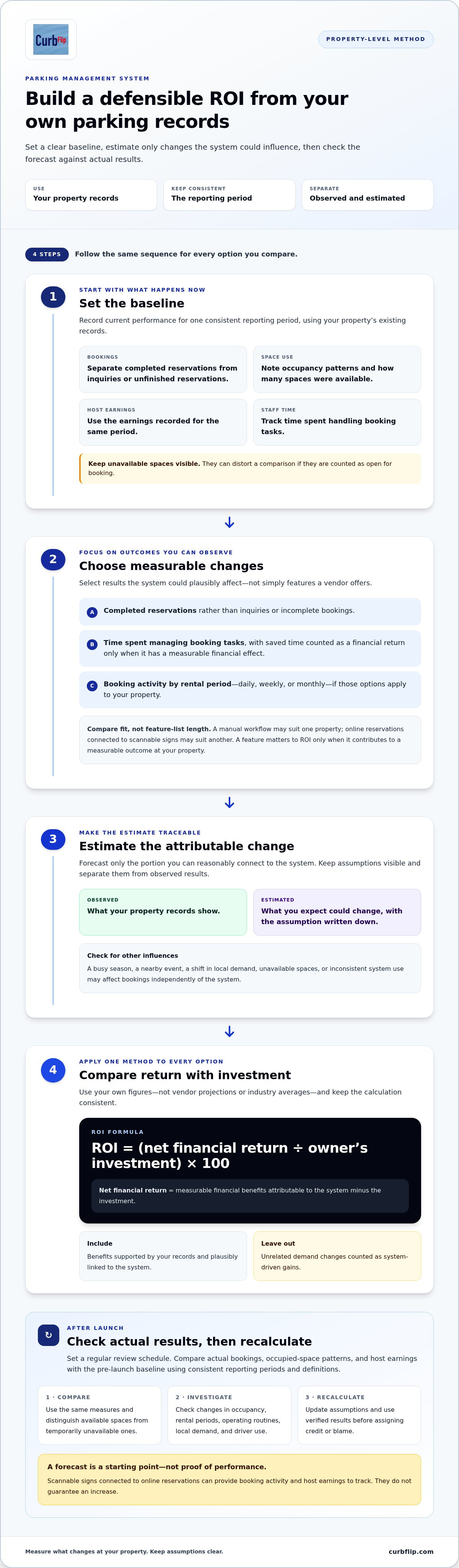
Use the same reporting period for your baseline and estimate. Then follow these four steps:
- Set the baseline. Record current bookings, occupancy, host earnings, and staff time using your property records. Note unavailable spaces so they don’t distort the comparison.
- Choose measurable outcomes. Focus on changes the system could plausibly affect, such as completed reservations or time spent managing booking tasks.
- Estimate attributable change. Forecast only the portion you can reasonably connect to the system. Keep assumptions visible and separate them from observed results.
- Compare return with investment. Apply the same calculation to each option, using your own figures rather than vendor projections or industry averages.
Compare approaches by fit and outcomes, not by the length of a feature list. A manual workflow may suit one property, while online reservations connected to scannable signs may better fit another. If drivers can reserve daily, weekly, or monthly, track completed bookings in each rental period and compare them with your baseline. A feature matters to your ROI only if it contributes to a measurable outcome at your property.
How do you compare estimated return with the system investment?
Use this formula: ROI = (net financial return ÷ owner’s investment) × 100. For a consistent calculation, define net financial return as the measurable financial benefits attributable to the system minus the investment. Include only benefits you can support with your records, and use the same definition for every option. Document which changes the system plausibly influenced, and don’t count unrelated shifts in demand as system-driven gains.
Use the parking platform comparison as one resource when weighing a signage-and-booking approach against your current process. If scannable signs are part of your assessment, explore the CurbFlip parking sign options and decide how their booking activity would fit your measures.
How to Validate ROI After Launch and Choose Your Next Step
A forecast is a starting point, not proof of performance. Set a regular review schedule and compare actual bookings, occupied-space patterns, and host earnings with your pre-launch baseline. Keep reporting periods and definitions consistent. For example, compare the same rental periods and distinguish spaces that were available to book from those that were temporarily unavailable.
What should property owners track after a parking system goes live?
Track the indicators you used in your original calculation. Note changes in available spaces, rental periods, operating routines, or local demand that could affect results. A property in New York, Chicago, or Austin should be assessed using its own booking patterns, not an assumption based on another market. Keep a simple record of what changed and when, so you can interpret results in context.
If actual results differ from the forecast, investigate before assigning credit or blame to the system. Check whether occupancy shifted, spaces were unavailable, or drivers used the booking process consistently. Then update your assumptions and recalculate ROI using verified results. This makes calculating ROI on a parking management system an ongoing review, not a one-time decision.
For owners who want to make spaces reservable, CurbFlip connects scannable parking signs with an online marketplace for daily, weekly, and monthly bookings. Booking activity and host earnings give you measures to include in your review, without assuming they will rise automatically. Explore the CurbFlip scannable parking signs to see how on-site signage can connect with online booking.
Make Your Next Parking Decision With Confidence
Reliable ROI starts with your property’s own records. Set a clear baseline, compare realistic outcomes with your investment, and revisit the numbers after launch. If bookings, occupancy, or host earnings differ from your forecast, investigate what changed before attributing the result to the system.
For owners making spaces reservable, CurbFlip connects scannable parking signs with an online marketplace that supports daily, weekly, and monthly bookings. This gives you a practical way to include sign-connected reservations when calculating ROI on a parking management system, while keeping your estimate grounded in observed results.
Explore CurbFlip scannable parking signs and see how they could fit your space. Start with your data, track the measures that matter, and use the results to guide your next decision.
Frequently Asked Questions
How do you calculate ROI on a parking management system?
Divide net financial return by your investment, then multiply by 100. Define net return consistently: subtract the investment from measurable financial benefits you can reasonably connect to the system, and document your assumptions. When calculating ROI on a parking management system, compare the result with a property-specific baseline rather than relying on projected performance.
What data do you need to calculate parking system ROI?
Gather baseline and post-launch records for bookings, occupancy, host earnings, and staff time. Use the same reporting periods and definitions for both, and separate observed figures from estimates. Note factors such as unavailable spaces or changes in local demand. A property in New York or Chicago may have different booking patterns from one in Austin, so use your own records.
Can a parking management system increase parking revenue?
It may support increased revenue if it helps make unused spaces bookable or makes reservations easier to complete, but results aren’t guaranteed. CurbFlip connects scannable parking signs with an online reservation marketplace for daily, weekly, and monthly bookings. Track completed reservations and host earnings to see whether this approach makes a measurable difference at your property.
How long should you measure ROI after installing a parking management system?
There’s no single review period that fits every property. Choose a consistent cadence and measure long enough to compare like with like, including relevant demand patterns and rental periods. Whether your property is in Los Angeles, Seattle, Atlanta, San Francisco, London, Denver, Miami, Dallas, Houston, Nashville, Memphis, New Orleans, Southern California, Toronto, Montreal, or Vancouver, investigate differences before attributing results to the system.
Disclaimer
The content provided in this article is for informational purposes only. All uses of the CurbFlip name, images, logos, and likeness are the exclusive property of CurbFlip.com. This article may contain information researched by a third-party, meaning CurbFlip does not guarantee the accuracy, completeness, or reliability of any third-party information presented herein and assumes no liability for any decisions made or actions taken based on this content.