

The most durable-looking parking sign may still be the wrong choice for your lot. The best material for outdoor parking signs depends on where it stands, how long it needs to last, and how drivers will read it.
Sun, rain, wind, and temperature swings can wear signs or make their message harder to see. The key is to balance weather exposure, visibility, placement, and your parking setup. This guide compares common options, including aluminum, plastic, wood, and vinyl, so you can match a sign to its location and expected use. You’ll also find practical ways to improve wording and placement. CurbFlip’s scannable parking signs connect physical signage with online booking, giving drivers a way to move from on-site directions to a reservation. Start with the conditions at the sign’s location, then choose for readability and use.
Key Takeaways
- The best material for outdoor parking signs depends on site exposure, intended use, placement, and mounting.
- Compare aluminum, corrugated plastic, and other common substrates based on your parking setup, not appearance alone.
- Use concise wording, clear arrows, and an easy-to-read layout to help drivers understand where to go and what to do.
- Scannable parking signs can connect on-site directions with online booking, helping drivers find and reserve the right space.
Best Material for Outdoor Parking Signs: Compare the Main Options
An outdoor sign’s material is its substrate, the base that holds the printed message and any protective or visibility layers. The best material for outdoor parking signs depends on the site and the sign’s job, not just its appearance.
Use the comparison below as a starting point. Outdoor performance depends on how a sign is made and finished, so check the manufacturer’s specifications for the specific product. Also consider whether the sign will stay in one place or need to be moved, and how it will be supported.
For a quick look at metal parking signs, watch this video:
How do common parking-sign materials differ outdoors?
Start with the substrate, then assess the layers that carry the message. Printed graphics, protective coatings, and reflective sheeting are separate parts of a sign. For example, retroreflective sheeting materials are designed to return light toward its source, but performance varies by product.
| Material | Practical strengths | Considerations |
|---|---|---|
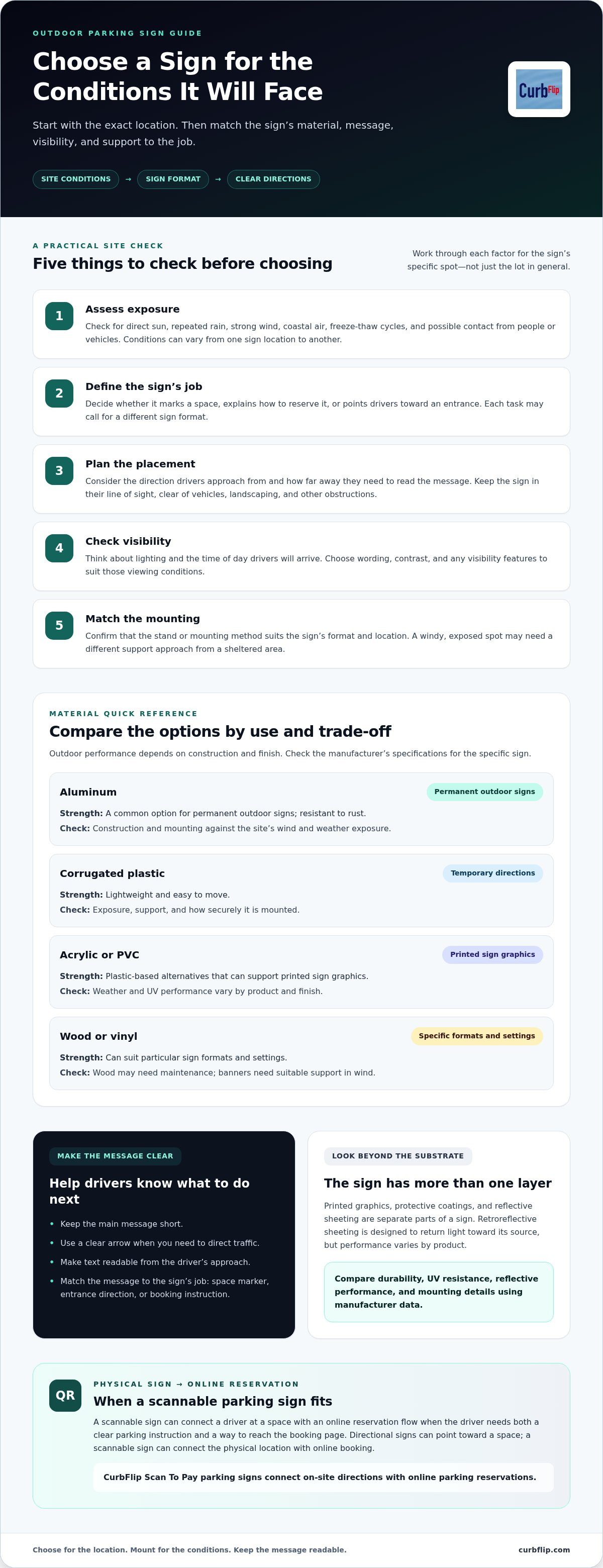
| Aluminum | A common option for permanent outdoor signs; resistant to rust. | Check the sign’s construction and mounting against the site’s wind and weather exposure. |
| Corrugated plastic | Lightweight and easy to move, which can suit temporary directions. | Suitability depends on exposure, support, and how securely it is mounted. |
| Acrylic or PVC | Plastic-based alternatives that can support printed sign graphics. | Weather and UV performance vary by product and finish. |
| Wood or vinyl | Can suit particular sign formats and settings. | Wood may need maintenance; banners need suitable support in wind. |
Compare durability, UV resistance, and reflective performance with manufacturer data. The right substrate and finish should suit the sign’s location and purpose, while the mounting should keep it visible and stable.
How to Choose Outdoor Parking Sign Material for Your Site
Choose based on what the sign will face and what drivers need it to do. The best material for outdoor parking signs fits the site’s exposure, purpose, viewing conditions, and mounting setup.
What should you check before choosing a material?
Work through these checks before selecting a sign:
- Assess exposure. Note direct sun, repeated rain, strong wind, coastal air, freeze-thaw cycles, and possible contact from people or vehicles. Conditions can differ from one block or lot to another, so assess the exact sign location.
- Define its purpose. Decide whether the sign marks a space, explains how to reserve it, or points drivers toward an entrance. A space marker, booking instruction, and directional sign may need different formats.
- Plan placement. Consider the direction drivers approach from and how far away they need to read the sign. Keep it in their line of sight without putting it where vehicles, landscaping, or other objects could block it.
- Check visibility. Consider the lighting and time of day when drivers will arrive. Choose a layout and any visibility features that suit those conditions.
- Match the mounting. Confirm that the stand or mounting method suits the sign format and location. A sign exposed to wind may need a different support approach from one in a sheltered area.
These checks apply whether you’re marking a driveway or shared lot in New York, Chicago, Los Angeles, Seattle, Atlanta, San Francisco, London, Denver, Miami, Dallas, Houston, Austin, Nashville, Memphis, New Orleans, Southern California, Toronto, Montreal, or Vancouver. For a general reference alongside your site assessment, see this outdoor sign planning reference. Use it as background, then follow the manufacturer’s guidance for the specific sign and mounting method. CurbFlip scannable parking signs connect signage to online parking reservations.
Make Outdoor Parking Signs Easy to Read and Use
A parking sign should help drivers decide what to do next. Keep the main message short, use a clear arrow when you need to direct traffic, and make the text readable from the driver’s approach. A sign marking a reserved space has a different job from one that guides drivers to an entrance or explains how to book.
Choose the substrate and sign format for the task, not appearance alone. The best material for outdoor parking signs is only part of the decision. Placement, contrast, graphics, and visibility features also affect how easily drivers can read the message. The Federal Highway Administration explains sign retroreflectivity, a feature that can help return light toward its source. Check the product details to see what a specific sign includes.
When does a scannable parking sign make sense?
A scannable sign can connect a driver who has arrived at a space with an online reservation flow. It’s useful when drivers need both a clear parking instruction and a way to reach the booking page. CurbFlip’s CurbFlip® “Scan To Pay” Parking Sign With Stand is one option. Directional signs can point drivers toward a space, while a scannable sign can connect the physical location with online booking.
For more on how scannable signs fit into parking rentals, read CurbFlip Scannable Parking Signs: The Ultimate Guide to Passive Parking Income in 2026. The CurbFlip parking signs store features options for parking directions and reservations.
Choose a Sign That Guides Drivers with Confidence
The best material for outdoor parking signs depends on your site conditions and the job the sign needs to do. Compare substrates, then consider exposure, placement, mounting, and how easily drivers can read the message. Clear instructions and useful directional cues matter as much as appearance.
Once you’ve settled on the setup, make it easy for drivers to understand where to park and how to reserve a space. CurbFlip scannable parking signs connect physical signage with an online reservation platform, with parking and directional sign options that include stands.
Explore CurbFlip scannable parking signs and choose an option to help drivers follow your parking instructions and book a space.
Frequently Asked Questions
What is the best material for outdoor parking signs?
The best material for outdoor parking signs depends on the location, exposure, and purpose. Aluminum is often considered for permanent signs, while corrugated plastic may suit signs that need to be lightweight or moved. Compare the substrate, printed graphics, coatings, and any reflective layer. Check the manufacturer’s specifications for the exact product before choosing.
Is aluminum or corrugated plastic better for outdoor parking signs?
Aluminum may suit a sign intended to stay in place, while corrugated plastic can work for temporary directions or a sign you need to move. Neither is right for every site. Consider wind, rain, sun, possible contact, mounting, and how long the sign will be used, whether it’s for a driveway in Chicago or an event in Los Angeles.
How do I make an outdoor parking sign easier to see?
Use a short message, readable text, strong contrast, and a clear arrow when drivers need direction. Place the sign where approaching drivers can see it without obstruction, and consider their viewing distance and approach angle. For a parking space in Seattle or an event in Miami, assess the actual site and lighting rather than relying on appearance alone.
Do outdoor parking signs need reflective material?
Not every parking sign needs reflective material. It can help drivers see a sign in low light when headlights illuminate it, but the right choice depends on where and when drivers need to read the message. Check the sign’s specifications and any requirements that apply to its setting. Reflective features are separate from the sign’s supporting substrate.
Disclaimer
The content provided in this article is for informational purposes only. All uses of the CurbFlip name, images, logos, and likeness are the exclusive property of CurbFlip.com. This article may contain information researched by a third-party, meaning CurbFlip does not guarantee the accuracy, completeness, or reliability of any third-party information presented herein and assumes no liability for any decisions made or actions taken based on this content.